

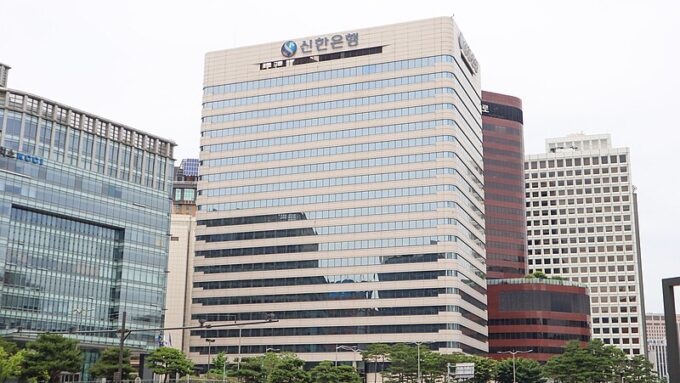
Shinhan Financial Group PER Stays Low – Solid Profit Growth Insight

Table of Contents
- 📰 Shinhan Financial Group Stock: What’s Happening Right Now
- 📊 Shinhan Financial Group’s Numbers: The Good, The Bad, The Ugly
- 🏦 What Wall Street Is Saying About Shinhan Financial Group
- 📈 Bull Case vs. Bear Case for Shinhan Financial Group
- ⚠️ The #1 Risk You Need to Know
- 🎯 Should You Buy Shinhan Financial Group Stock? My Honest Assessment
- ❓ Frequently Asked Questions About Shinhan Financial Group
- Is Shinhan Financial Group stock a good buy right now?
- What is Shinhan Financial Group’s stock price target?
- What are the biggest risks of investing in Shinhan Financial Group?

신한지주 📊 Analyst Consensus · 20 Analysts
Low Target
₩93,000
Avg. Target
₩120,370
+21.1% upside
High Target
₩136,000
💡 KEY TAKEAWAY
Shinhan Financial Group is trading at a 7.7x forward-style PER while delivering solid profit growth—net income rose +25.7% YoY in the latest quarter. With the stock price already below the average analyst target, the risk/reward still favors buyers who can stomach financial-sector cyclicality.
Shinhan Financial Group matters today because the market is pricing it like a “normal” bank holding company, even as the latest quarterly numbers show profit growth that refuses to behave like a dull, mature story. The surprise is not the revenue trend—revenue growth is modest at +4.4% YoY—but the earnings profile: net income jumped +25.7% YoY. That kind of earnings acceleration, especially alongside a low 7.7x valuation multiple, is exactly when investors should ask a sharper question: is the market underestimating the earnings power, or is it overestimating sustainability?
There’s also a narrative layer behind the ticker. Recent news flow points to leadership moves in Shinhan’s Life and Asset Management units and chairman-candidate selection discussions alongside peers. In financials, leadership transitions don’t automatically create value—but they can change execution speed, product mix, and capital allocation discipline. Combine that with record-high momentum reported for major financial holdings, and you get a setup where sentiment can re-rate quickly if guidance and capital efficiency remain intact.
📈 Shinhan Financial Group 실시간 주가
신한지주 📰 Shinhan Financial Group Stock: What’s Happening Right Now
Let’s start with what the headlines are really signaling. Shinhan Financial Group has been in the news for appointing new CEOs for its Life and Asset Management businesses. That matters because these segments typically drive the holding company’s longer-duration earnings stability—through fee income, asset-based revenues, and the ability to manage liabilities and investment portfolios through the cycle. When management changes at the unit level, investors should watch for two things: whether strategy becomes clearer and whether product and distribution execution improves. The market tends to wait for proof, but when profit growth prints, the wait can end faster than most expect.
At the same time, broader news mentions that “four major financial holdings” hit new highs. Even without the full text, this is a useful market signal. It suggests that investors have been willing to pay up for the sector’s quality and balance-sheet resilience. Shinhan Financial Group, however, is not priced like it has already “caught up.” With the current stock price at ₩99,500 and a 52-week range from ₩50,900 to ₩107,200, the stock is near the upper portion of the range but still below key valuation anchors from analysts.
And that anchor is the analyst target: the average target price is ₩120,370, with a high of ₩136,000 and a low of ₩93,000. In other words, the Street is not calling this “done.” It’s calling it “mispriced.” Why would that be? The simplest answer is the earnings engine. Revenue growth is positive but not explosive, yet net income surged. When that happens, markets often chase the stock after the earnings revision cycle starts—unless the numbers are a one-off. So the near-term question for Shinhan Financial Group is whether the profit acceleration is durable enough to justify re-rating from “cheap” to “fairly valued” or even “premium” within the group.
신한지주 📊 Shinhan Financial Group’s Numbers: The Good, The Bad, The Ugly
The latest quarterly comparison (2025.12 vs 2024.12) gives Shinhan Financial Group a clean earnings story. Revenue came in at ₩48,029억, up +4.4% YoY from ₩46,000억. That’s steady growth—nothing to brag about—but it’s not a red flag either. The real story is net income: Shinhan Financial Group reported ₩5,106억 of net profit, up +25.7% YoY from ₩4,060억. When net income grows more than revenue, it usually means costs, credit quality, operating leverage, or investment income swung in the right direction.
Now zoom out to the valuation and profitability snapshot provided by the real-time dataset. The company’s leading PER is 7.7, which is low for a financial holding company in a market that has shown willingness to bid up sector leaders. Profitability signals are mixed but still supportive: operating margin is 51.4%, while the dataset lists gross margin as 0.0%. That “0.0%” figure is a data artifact risk in bank/financial reporting formats, so investors should focus more on operating profitability and bottom-line growth rather than interpreting gross margin the way they would for a manufacturer. Return on equity is ROE 8.6%, which is not “hyper-growth,” but it is solid enough to justify the multiple if capital efficiency holds.
Did Shinhan Financial Group beat expectations? The dataset does not include explicit analyst EPS estimates or guidance numbers, so we can’t quantify “beat by X%” in a strict way. But the earnings acceleration (net income +25.7% YoY) is the kind of result that typically creates positive revisions. If analysts are already at a consensus of Strong Buy, that usually reflects either confidence in forward earnings or belief that current earnings power is under-recognized.
One sentence interpretation: the numbers suggest Shinhan Financial Group is converting modest top-line growth into materially faster profit growth, and at a 7.7x valuation that combination can attract incremental capital.
🏦 What Wall Street Is Saying About Shinhan Financial Group
Wall Street’s stance on Shinhan Financial Group is unambiguous in the dataset: the consensus is Strong Buy with a score of 1.40 and coverage from 20 analysts. That’s a meaningful breadth of opinion. The average analyst price target is ₩120,370, implying upside from the current ₩99,500. The target range is wide enough to matter: high ₩136,000, low ₩93,000. A low target below the current price suggests some analysts are either cautious on downside risks (credit costs, regulation, or macro) or believe the earnings jump may normalize.
Valuation is the other anchor. With a leading PER of 7.7, Shinhan Financial Group is not priced like a company that must deliver heroic growth. That typically means analysts are betting on either (1) sustained earnings conversion (profit growing faster than revenue), or (2) multiple expansion as confidence rises. In my view, the latter is less speculative than it sounds. When an earnings trend improves, investors often stop treating the stock as “cheap for a reason” and start treating it as “cheap because expectations were too low.”
Are analysts missing something? The main counter-argument is that financial-sector profits can be volatile. Net income growth can reflect favorable items—investment gains, lower provisioning, or timing effects. If those were one-time, future quarters could disappoint and the stock could drift toward the low end of the target range. But the market is already telling a story of sector strength, and Shinhan Financial Group is showing bottom-line momentum. So the Street’s bias toward Strong Buy looks justified—assuming management execution and credit discipline hold.
📈 Bull Case vs. Bear Case for Shinhan Financial Group
🟢 Bull Case
- Earnings conversion improves: net income rose +25.7% YoY while revenue grew only +4.4%, signaling operating leverage and/or favorable cost/credit dynamics.
- Valuation supports re-rating: at a 7.7x PER, even modest confidence upgrades can pull the stock price toward the ₩120,370 average target and potentially the ₩136,000 high.
- Unit leadership momentum: new CEOs in Life and Asset Management can sharpen product mix and distribution, strengthening fee income and smoothing earnings volatility over time.
🔴 Bear Case
- Profit growth may normalize: the gap between net income growth and revenue growth could reflect temporary factors; if they fade, earnings revisions could reverse.
- Credit and macro risk: financial-sector EPS is sensitive to provisioning and interest-rate/inflation shocks; a deterioration could compress margins and ROE.
- Valuation isn’t a safety net: a low PER can stay low if investors lose confidence; the ₩93,000 low target indicates some analysts see meaningful downside.
⚠️ The #1 Risk You Need to Know
The single biggest risk for Shinhan Financial Group is that the earnings acceleration (net income +25.7% YoY) proves partly non-recurring—through timing effects in investment income, a one-off reduction in credit costs, or accounting/reporting differences. If the next couple of quarters show net income growth slowing sharply while revenue remains only mid-single-digit, the stock price could re-rate downward even if the company remains fundamentally sound.
🎯 Should You Buy Shinhan Financial Group Stock? My Honest Assessment
I rate Shinhan Financial Group a buy—but not because it’s a “story stock.” It’s a buy because the current stock price of ₩99,500 sits below where the Street thinks it should trade, while the latest quarter shows profit growth that is outpacing revenue. The valuation setup matters too: 7.7x PER is the kind of multiple that gives you room for execution, not just for optimism.
Who is this for? Shinhan Financial Group fits value-to-quality investors who want exposure to financials without paying a premium multiple, and it can also suit income-oriented investors looking for stability—though the dataset doesn’t provide dividend specifics, so focus on earnings power rather than yield. For speculators, the upside toward the ₩120,370 average target is attractive, but the downside risk tied to credit/provisioning is real.
What price level makes sense? I would treat ₩95,000–₩100,000 as a reasonable entry band given the current price and the analyst low target of ₩93,000. If the stock dips closer to the low end, the margin of safety improves. If it rallies quickly above ₩107,200 (the 52-week high), you can still buy, but you should expect more volatility in the next earnings cycle as the market tests whether profit growth is repeatable.
Timeline: this is a 12–24 month hold thesis rather than a one-quarter trade. The reason is simple: re-rating in financials usually needs at least two quarters of consistent earnings conversion and capital efficiency.
❓ Frequently Asked Questions About Shinhan Financial Group
Is Shinhan Financial Group stock a good buy right now?
Yes. With Shinhan Financial Group trading around ₩99,500 and showing net income growth of +25.7% YoY alongside a 7.7x PER, the risk/reward still favors buyers. The key is monitoring whether the profit acceleration repeats in subsequent quarterly results.
What is Shinhan Financial Group’s stock price target?
The average analyst price target is ₩120,370, with a high of ₩136,000 and a low of ₩93,000. My view aligns with the average: I’d expect Shinhan Financial Group to trend toward ~₩120,000 if earnings conversion remains strong.
What are the biggest risks of investing in Shinhan Financial Group?
The top risks are: (1) non-recurring drivers behind net income growth, (2) credit costs and macro sensitivity that can hit EPS quickly, and (3) valuation complacency where a low PER persists if investors lose confidence in forward earnings.
That’s my read on Shinhan Financial Group based on the real-time financial snapshot and the current Street consensus. This is not financial advice—just an investment journalist’s analysis of what the numbers and the market signals are implying. If you’re already in the name, what level are you watching next—₩107,200 as resistance, or ₩93,000 as a downside line? Share your take in the comments.
📌 Related Articles

댓글이 닫혔습니다.